
Every gardener knows that healthy plants start with healthy soil. But what does healthy soil look like and how do you get it?
That’s the question I asked myself not long ago. I knew that there are different types of soil, such as clay soils or sandy soils, and that soil that contains nutrients is better for growing vegetables, or any plant for that matter.
But that is only part of the picture. My research has discovered that there is much more to it than that.
So what is healthy soil for a vegetable garden in the UK and how do you get it? Read on to find out…
What Constitutes Healthy Soil?

If you scour the internet, you will mostly find articles about how it’s important to add organic matter to soil, as it improves soil structure and water retention.
And while these things are important, as it provides your vegetable plants with the nutrients and water conditions they need, it’s not what makes soil healthy.
Soil health isn’t just about creating the right conditions for the plants. Growing plants is only one of the several functions soil performs. Unfortunately, it’s the only one that we humans seem to consider.
Instead, soil has a multifunctional nature and for it to be healthy it has to be able to perform all these functions (Kopittke et al., 2023)
According to Kopittke et al., soil has five functions:
- Biomass production – this basically means soils is responsible for growing plants
- Regulation of the carbon (C) pool – carbon is a vital building block of life and soil absorbs and releases it, thereby regulating the C pool
- Nutrient cycling – soil absorbs and releases nutrients – plants get their nutrients from the soil, as we know, and without them we couldn’t grow anything
- Water cycling – soil stores a huge amount of water, which is vital for plants as well as us humans
- Habitat for biodiversity – 25% of global biodiversity is in the soil, and these organisms are vital to help the soil perform its other functions (Lehman et al., 2015)
Because we haven’t paid much attention to the multifunctional nature of our soil, a third of the world’s soil is faced with moderate or severe degradation. (Vargas Rojas et al., 2016)
You might wonder why we go into so much detail. After all, you just want to know how you can get healthy soil to grow strong and healthy vegetable plants that produce a good yield, right?
Well, here’s the thing. All of the above mentioned functions the soil performs are vital if you want to grow healthy vegetable plants.
5 Steps To Create Healthy Soil For A Vegetable Garden In The UK
We have already said that the soil organisms are vital if the soil is to perform all its functions. And the more diverse the soils microbiome is, the better it is in doing so.
For example, soils with high microbial diversity have a larger C pool than soils with a diminished diversity. (Demyanyuk et al., 2019) This shows that the soils microbiota is important for the soils ability to regulate the C pool.
Therefore, soil microorganisms and their variety are a key element of healthy soil. (Shah et al., 2021) This means, if you ensure that the soil in your vegetable garden has a good level of microbial biodiversity, you have healthy soil.
And here are the things you can do to achieve this.
1. Switch To A No-Dig Garden
One way the community of soil microorganisms can get disturbed is by agricultural practices, such as tilling and ploughing. (Griffith and Philippot, 2013)
While you won’t do either of those, most vegetable gardeners regularly dig in organic matter to add nutrients and improve the soil structure.
Like the agricultural practices, digging a vegetable bed disturbs the soil microbiome, leading to diversity loss, which can degrade the soil and impair soil health.
No-dig gardening means that you don’t dig over your bed or dig in organic material. Instead you add a layer of organic matter, such as compost or mulch, on top of the bed.
This will slowly add nutrients to the soil without disturbing the microbial soil community underneath.
Read our guide about how to start a no-dig garden, to learn more about the no-dig method.
2. Stop Using Pesticides

Pesticides are chemicals that eliminate pests or weeds by killing them. As you might imagine, they don’t just kill the target species, but many others too.
It’s been scientifically proven that pesticides are responsible for a reduction in biodiversity of soil microorganisms, as well as the activities they perform. (Hussain et al., 2009)
Furthermore, they can also be harmful to beneficial creatures such as earthworms (Jeyaprakasam et al., 2020)
So to protect your soil’s microbiome and other helpful organisms it’s vital that you stop using pesticides.
There are many other ways to keep pests and weeds at bay without resorting to pesticides. Companion planting and attracting beneficial insects to your garden are two methods.
We created a wildflower meadow in our garden which attracts many helpful insects that control pests and keep our veggies safe.
But creating physical barriers is another natural way to prevent pests from destroying your crop and weeds from growing.
So by not using pesticides you can ensure you have healthy soil for your vegetable garden in the UK.
3. Stop Using Chemical Fertilisers
Did you know that plants struggle to absorb nutrients, such as nitrogen or phosphorus, from chemical fertilisers? This means many stay in the soil, which can lead to biodiversity loss and soil degradation. (Galloway et al., 2003)
The reason why plants can’t easily take up phosphorous is that most of it in the soil is non-soluble. It’s soil bacteria that make it soluble and thereby useful for plants. (Khan et al., 2017)
So it’s vital that you have the right beneficial bacteria in your soil.
This doesn’t mean that you don’t have to add nutrients to your soil, for one you need to feed the soil’s microbiome. But rather than using chemical fertilisers, use natural ones.
Add a layer of organic material, such as homemade compost, compost from your wormery, or leaf mulch, to your beds in autumn. This mimics nature’s way of replenishing the soil with nutrients.
Think of it, in autumn the leaves fall to the ground, where they slowly decompose and release nutrients. Adding leaf mulch or compost does the same thing.
When it comes to feeding your plants, skip chemical liquid feeds and make your own liquid fertilisers, from weeds, coffee grounds, or kitchen scraps.
Or even better, use the liquid you get from a wormery. Not only does it contain vital nutrients, but also beneficial bacteria, or probiotics. (Yatoo et al., 2021)
On top of that, the worms also produce a substance that kills pathogens, harmful organisms, and this substance is also in the worm juice, helping to keep your plants healthier (Alkobaisy et al., 2021)
This will ensure that you keep your plants and the soil microbes well fed with synthetic chemicals.
4. Change To A Polyculture Approach In Planting
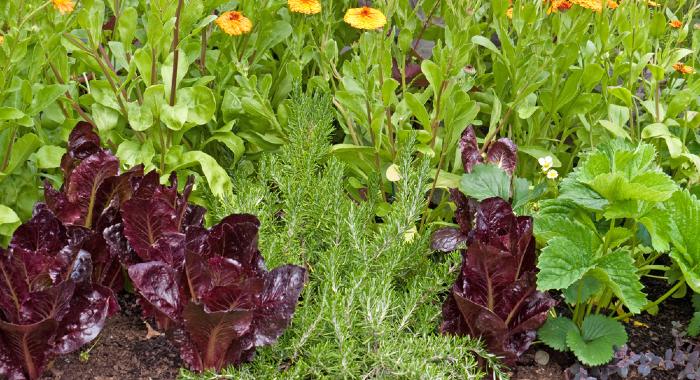
Most vegetable gardeners practice monoculture in their veg patches. This means they only grow one type of plant per bed. One with carrots, one with onions, one with tomatoes, and so on.
This lack of biodiversity above ground, leads to reduced biodiversity below ground. A thriving soil microbiome needs a variety of plants. (Hermans et al., 2023)
One way to create a polyculture is to adopt companion planting, a gardening method used for organic farming. By planting different veggies together you can get various benefits, such as pest control, weed suppression, attracting pollinators, and more.
Read our guide about companion planting to find out more.
Or you can plant your veggies among your flowers. Why not grow edible flowers which you can plant with your veggies. This will increase the biodiversity above ground and you increase the produce you grow for your kitchen.
My guide about how to grow edible flowers will tell you all you need to know.
5. Practice Crop Rotation
Every gardener will tell you that you should practice crop rotation to avoid a build up of pests and diseases in the soil. But it does more than that.
Studies have shown that crop rotation increases the number of beneficial organisms in the soil, as well as improving the water uptake and storage in the soil. (Shah et al., 2021)
So what is crop ration? It basically just means that you don’t grow the same vegetable plants from the same family in the same bed every year.
So if you grow tomatoes in a bed one year, you don’t grow them again in the same bed the year after. And you also don’t grow other members of the same plant family, such as potatoes or peppers.
Not sure where to start? Our guide about starting a crop rotation will help you plan and succeed rotating your crop every year.
There you go, this is how you can create healthy soil for a vegetable garden in the UK. Start now with the first step and take it from there.


